
Booking that first fertility appointment can take courage. You may have been trying for months or years, fielding questions from relatives at every family function and worrying quietly at home. Feeling nervous is completely normal.
It helps to know what the visit involves. Most couples walk out with a clear next step and feel lighter for it.
When should you book a fertility consultation?
The general advice is to seek help if:
- You are under 35 and have not conceived after 12 months of regular unprotected intercourse
- You are 35 or older and have not conceived after 6 months
- You have irregular or absent periods, known PCOS, endometriosis or previous pelvic surgery
- You have had two or more miscarriages
- Your partner has a known sperm problem, previous testicular surgery, or has had mumps affecting the testes
If something worries you, there is no need to wait. Some couples come before they even start trying, just to plan. Our preconception care checklist covers that stage.
What to bring to your first visit
Coming prepared saves time and avoids repeat tests. Try to bring:
- All previous reports, scans and prescriptions for both partners, in date order (a simple file folder works well)
- Any semen analysis reports
- Details of earlier treatment such as ovulation tablets, IUI or IVF, with medicine names and doses
- A note of your periods for the last few months: start dates, length and flow
- A list of current medicines and supplements
- Your questions, written down so you do not forget them on the day
What happens during the consultation
Most first visits follow a similar pattern.
1. A detailed conversation
We will ask about:
- How long you have been trying and how often you have intercourse
- Your cycle, pain, discharge or bleeding between periods
- Previous pregnancies, miscarriages or abortions
- Medical conditions such as thyroid disease, diabetes or tuberculosis
- Previous surgery, especially on the abdomen or pelvis
- Work, stress, sleep, smoking, alcohol and diet
- Your partner's health, habits and any earlier tests
Answer as openly as you can. Everything you tell us stays confidential, and it helps us understand what is going on.
2. Examination
This may cover your height, weight and blood pressure, signs of hormonal imbalance and, if appropriate, a pelvic examination.
3. Ultrasound
A transvaginal ultrasound is often done at the first visit or early in your next cycle. It shows the uterus and its lining, any fibroids or polyps, and the ovaries. Counting the small follicles in the ovaries (the antral follicle count) gives a sense of ovarian reserve. If your AMH turns out low, our guide to low AMH and ovarian reserve explains what that means.
4. A plan for tests
At the end, we explain which tests you need and when to do them.
Tests that usually follow
For the woman
- Hormone tests, often on day 2 or 3 of the cycle, such as FSH, LH and AMH, plus thyroid function and prolactin
- Tests to confirm ovulation, such as follicle tracking scans or a mid-luteal progesterone level
- A tubal test, such as HSG or sono-HSG, to check whether the fallopian tubes are open
- General health tests, such as haemoglobin, blood sugar and infection screening
- Hysteroscopy or laparoscopy, only if there is a specific reason
For the man
- Semen analysis, usually after two to five days of abstinence. Our guide to the semen analysis report explained helps you make sense of the numbers.
- Further tests, such as hormone levels or a scrotal ultrasound, if the semen analysis is abnormal
Questions worth asking
You may want to ask:
- What do you think is the most likely reason we have not conceived?
- Which tests do we need, and in what order?
- What are our treatment options, starting with the simplest?
- How long should we try each step before moving on?
- What can we do at home to improve our chances?
- What will each stage cost, and how much time will it take?
- Who do we contact if we have a question between visits?
A good fertility specialist will answer patiently, in plain Hindi or English, whichever you prefer.
What comes next
Once the results are in, there is a follow-up visit to discuss the diagnosis and a treatment plan. Depending on what we find, that might mean lifestyle changes, ovulation induction, surgery, IUI or IVF. Our article on IUI vs IVF explains how doctors choose between the two.
Treatment moves one step at a time. Take time to think, ask more questions or get a second opinion before you decide. That is fine.
Looking after yourselves along the way
Fertility tests and treatment are emotionally tiring for both partners. Decide together how much you want to share with family. Keep some time for things you enjoy. Talk to each other honestly about how you feel. If the stress gets heavy, tell your doctor. Counselling is a normal part of good fertility care, not a sign that you are failing to cope.
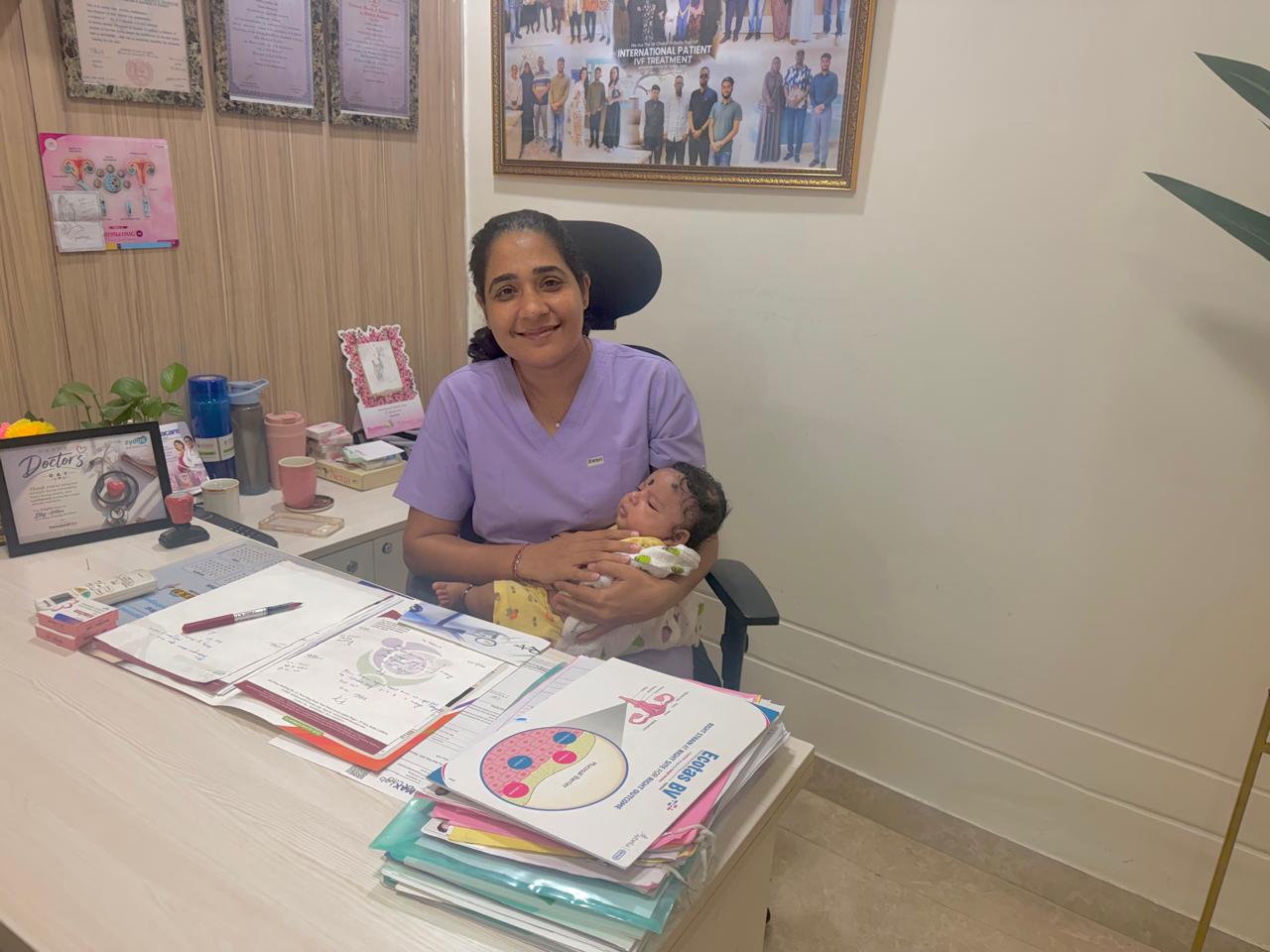
Your first fertility visit with Dr. Kavita in Kamla Nagar, Delhi
Dr. Kavita Manchanda is a fertility and IVF specialist with FNB training in Reproductive Medicine and over 15 years of experience. She evaluates both partners and offers a full range of fertility treatments and women's care services. If you are searching for the best fertility doctor in Delhi or a fertility clinic in North Delhi, she consults at Penicillin Clinic in Kamla Nagar, convenient for couples from GTB Nagar, Mukherjee Nagar, Civil Lines and Rohini. Consultations are in Hindi and English. Book your first consultation and get clear, honest answers from the start.
Frequently asked questions
Yes, if he can. Male factors play a part in a large share of fertility problems, and a semen analysis is one of the first tests. Coming together also means you both hear the same thing and can decide together. If he cannot make it, we can still start your evaluation and plan his tests separately.
Possibly. A pelvic examination and a transvaginal ultrasound tell us a lot about the uterus and ovaries. The doctor will explain why it is needed and ask for your consent first. If you are not comfortable, or it is the wrong time of your cycle, it can wait for a later visit.
The basic tests for both partners can usually be finished within one or two menstrual cycles, because some are timed to particular days of the cycle. For some couples every test comes back normal. That is called unexplained infertility, and there are still clear treatment options for it.
No. Many couples need only simple steps such as timed intercourse, ovulation medicines, treating a thyroid problem or changing a few habits. IUI and IVF are suggested only when the tests and your situation point that way.

Dr. Kavita Manchanda
MBBS, MS (OBG), DNB (OBG), FNB (Reproductive Medicine). Fertility and IVF specialist with 15+ years of experience in male and female fertility, IUI, IVF, TESA, laparoscopy, hysteroscopy, pre-conception and antenatal care. Consults at Penicillin Clinic, Kamla Nagar, New Delhi.
This article is for general information and does not replace a personal consultation. Every patient is different, so please speak to a qualified doctor about your situation.